JACK'S BLOG
|
|
Cuba
Like everyone else, Fidel was many things, many different things. What he was and what he became were vastly different images of the man. What he appeared to be depended on your point of view and the age at which you viewed him.
0 Comments
CubaFather forgive me for I have sinned. How long has it been since your last confession. A pause. A shrug.  Click to read the story How have you sinned, my son?
I've murdered men. Men? Yes, many. How many? Another pause. Another shrug. And? I've tortured many more. Why? They displeased me. How? They disagreed. Do you wish to confess another? I've sent others to murder and torture on my behalf. Who? Ernesto. Ernesto? Che. Ummm. He must confess his own sins. He didn't. No? A laugh. It's funny? Yes. Che never believed that he'd sinned. No? That's why I killed him. You murdered Che? CubaThere's a political proverb that “Only Nixon would go to China”, meaning that “only a politician or leader with an impeccable reputation of upholding particular political values could do an action in seeming defiance of them without jeopardizing his support or credibility”. (Wikipedia) 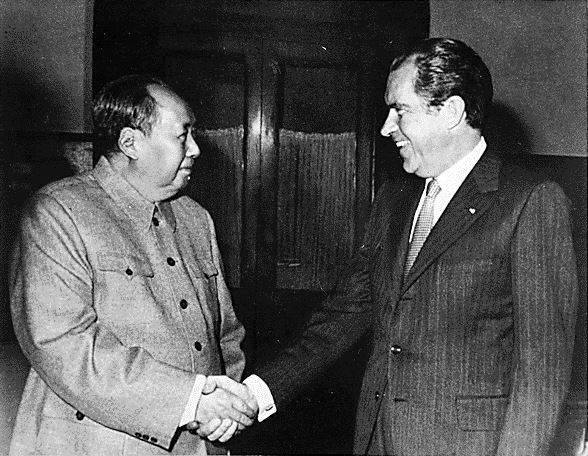 President Nixon meeting Chairman Mao President Nixon was a hardliner when it came to dealing with the communists. No one would suspect him of coddling them by visiting China and opening formal relations, but he did. Even those who did not suspect that Nixon's intent was to leverage the Chinese against the Soviets never questioned his motives. They trusted him to be tough with communism regardless of appearances.
Yes, you know where I'm going with this, don't you? Do we trust President Obama's motives in opening formal relations with Cuba? Can we say with equal confidence that “Only Obama could go to Cuba?” 1/15/2013 10 Comments Do you want to know the rest of the story? Show me you're interested. Read Rebels on the MountainSOME OF MY REGULAR blog followers have complained privately. Why didn't I finish the story of Fidel Castro's revolution? Why did I stop telling the story in my blog leaving Fidel and his small band of poorly armed, poorly supplied, and poorly led rebels surrounded on a mountaintop in Eastern Cuba? How did he defeat a modern, well-equipped, and well-trained army of 40,000 with fewer than 300 Fidelistas? How did he accomplish this amazing feat in just two years? It sounds eerily similar to the story of 300 Spartans almost defeating the Persian hordes at Thermopylae, doesn't it? What is the rest of the story? 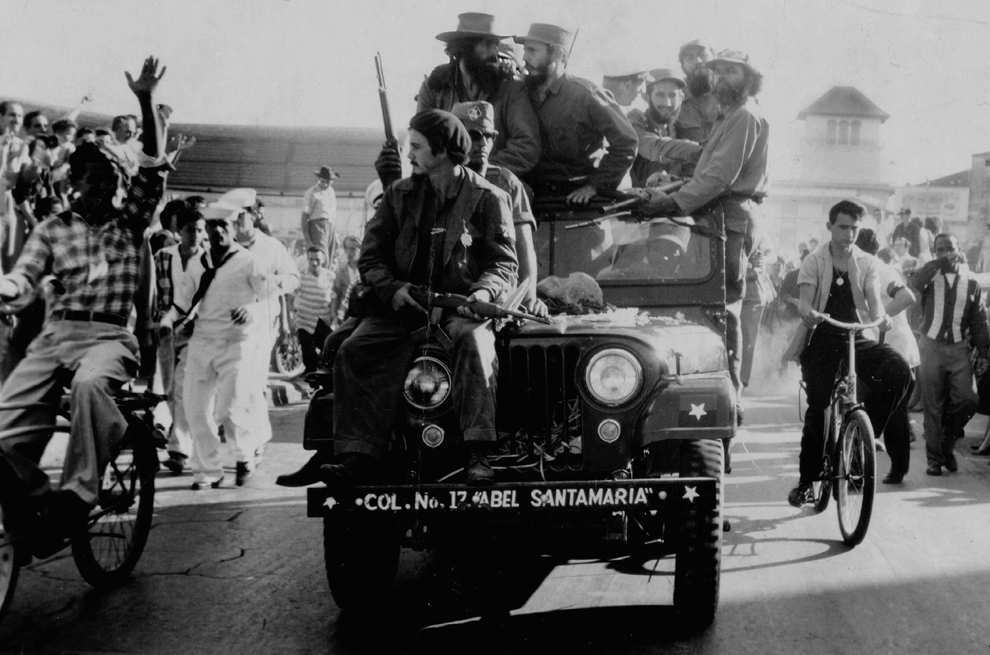 Fidel Castro rides with his most competent lieutenant, Camilo Cienfuegos (Castro's right) to Havana after Batista fled (click to enlarge) The truth is that I've already told the rest of the story in my novel Rebels on the Mountain. I've used this blog to provide readers with the background story of Cuba, from pre-Columbian Times until the year when Castro and his men arrived from Mexico on the motor yacht Granma. It's all here. I will soon collect these postings into a single volume. I'll let you know when it's available.
Rebels on the Mountain is as historically accurate as I could possibly make it. Still, it is a work of fiction. Too much of the history is lost in hyperbole and propaganda. Also, I used fictional characters to provide readers with a point of view and help explain the events that occurred during Castro's revolution. I have not yet decided whether or not to write a sequel to Rebels on the Mountain to help people understand what happened to Castro after the revolution. How did he transform from a spirited rebel leader into a tyrannical dictator? How did he become an enemy of America? Why did President Eisenhower refuse to meet with him? Why did President Kennedy authorize and then repudiate the Bay of Pigs invasion? I would love to understand how Ernesto Che Guevara became a popular icon when, in fact, he was Castro's murderous executioner until even Fidel could no longer stomach him. That will remain a mystery. However, it is no mystery as to why Castro continued to promote Che as a hero of the revolution. Would you like to know why? That story will be easy to tell if I decide to tell it. What will inspire me? Demand. Your demand. Read Rebels on the Mountain. Then I will know that you really want to hear the rest of the story. CubaTHE FEW FIDELISTAS who survived the ambush at Alegrío del Pio when they disembarked from the Granma, had a big job ahead of them. Most of them were from the cities and educated. They had little in common with the recruits who came from the ranks of the outcasts and outlaws who populated the Sierra Madres mountains at the eastern end of Cuba. 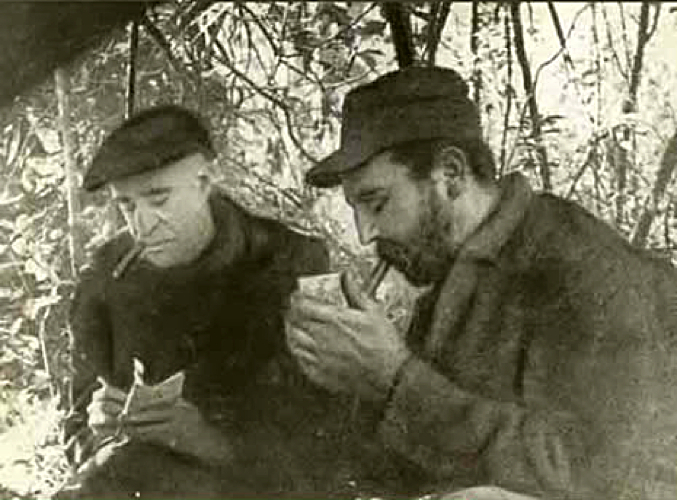 New York Times correspondent Herbert Matthews provided an independent report of the Fidelistas' camp on Pico Turquino when he interviewed Fidel Castro there (click to enlarge) Inasmuch as I am a trained infantry officer, I understood the kinds of training that they would need. The interesting part of writing Rebels on the Mountain came in creating methods of providing infantry training without the facilities and equipment that I had when I attended Infantry School. There was no record left by the Fidelistas describing their techniques, at least none that I could locate, and the only two surviving rebels, Fidel and Raúl Castro, aren't available for an interview.
Unfortunately, the few descriptions I could find concerning the conduct of the Cuban Revolution, are highly suspect. Like most propaganda, the narratives are mostly apocryphal. Fidel, I suspect, wasn't much use for training the new recruits. He hadn't demonstrated any capacity for battlefield leadership during his aborted raid on the army barracks at Moncada, the one that landed him in jail. Also, during the stay in Mexico while his men were training, Fidel was constantly engaged in raising funds for his invasion. Ultimately, the only references I could find that mentioned Castro's participation in battles referred to the fact that he fired the first shot signaling the commencement of an attack. Raúl Castro and Camile Cienfuegos were Fidel's chief lieutenants during those early days. Camile, hardly known in America outside of Cuban-American communities, probably was Fidel's best field commander. His photographs reveal a man of intelligence and humor, the kind that soldiers like to follow. It is doubtful that Raúl would have held any position of importance except by nepotism. Che was the doctor although he groused continually that he wanted to fight. However, he had no training and, ultimately, proved to be an inept commander, especially at the Bay of Pigs invasion. That left about eight Fidelistas to provide training to approximately 200 recruits. I calculated that they must have been divided into platoons of about thirty each with one Fidelista assigned to lead them in the capacity of a sergeant I supposed. These would be manageable training units. Every recruit brought their own weapon as Castro had none with which to arm them. One can only imagine the problems this created with supplying different caliber ammunition. How they were able to train these men to move, shoot, and communicate, as a combat team is the stuff of legend. I really enjoyed speculating as I wrote Rebels on the Mountain. CubaTHE GRANMA RAN AGROUND about 100 yards offshore. Castro and his Fidelistas had to wade ashore at a place known as Alegrío del Pio, about fifteen miles east of their intended destination. The few survivors reported that they waded through waist deep waters as though in slow motion. This would be consistent with a heavily laden cabin cruiser approaching a sloping beach. Their distress was most likely the result of short rations while living in cramped quarters, unable to move about for seven days. 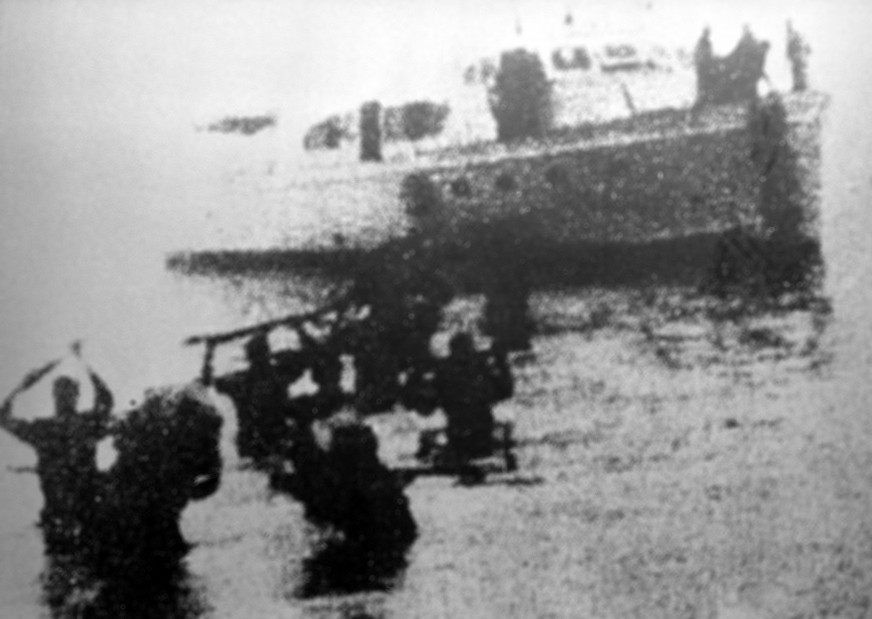 The Fidelistas appear as ghosts in this grainy photograph taken as they waded away from the stranded Granma (click to enlarge) Studying that stretch of coastline, it appears that it is a mangrove swamp. This might explain why the Cuban army and air force had to wait a day or two to spring their ambush. The rebels weren't a good target until they wandered inland. It is doubtful that they found food and water in the swamp and must have made some bad decisions about keeping under cover when they left the mangroves. They came under fire as soon as they entered the edges of a nearby sugar plantation.
During the brief ambush, the rebel ranks were decimated. The three principal leaders, Fidel, his brother Raúl, and Camile Cienfuegos, remained unscathed. Che Guevara suffered several severe bullet wounds and had to be carried to safety. During the next few days, most of the survivors of the initial onslaught were hunted down and killed or captured. Only eleven of the band of 82 were able to escape into the Sierra Madres Mountains that dominate the Oriente Province at the eastern end of Cuba. Every Cuban revolution began, and was mostly fought, in the Sierra Madres. Pico Turquino, the tallest of them, became the base camp for the Fidelistas. Pico Turquino is the mountain in my novel, Rebels on the Mountain. Fidel lost the majority of his trained forces in that brief attack. Although not mentioned in any record that I could find, they must have been intended as trainers for volunteers that Fidel expected to recruit on the island. One of Fidel's loyal lieutenants from the 26th of July Movement (MR 26-7), Celia Sanchez, had been recruiting in the Sierra Madres mountains in anticipation of his arrival. She had the pick of many outlaws and outcasts who populated the mountains and fought the hated Rural Guards of the Cuban army from the age when they had first been able to pick up a gun. Although they had valuable local knowledge and ample courage, they needed training to become an effective fighting force that could drive the dictator, Fulgencio Batista, and his henchmen from the island. That was the purpose of the trained Fidelistas who had arrived on the Granma. Now, there were just eleven of them remaining. CubaFEW OF THE FIDELISTAS who sailed on the yacht Granma and came to be known as los expedicionarios del Yate Granma, survived their arrival in Cuba. It is ironic that they survived the trip on an ill-suited vessel, to die in an ambush set by the Cuban army and air force. 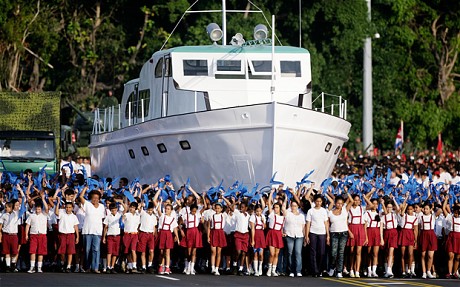 A replica of the Granma mounted on a truck chasis appears regularly at patriotic celebrations (click to enlarge) The pilot, Norberto Collado Abreu, a World War II veteran of the Cuban Navy, hadn't allowed for the loss of speed carrying so many men as well as their weapons, ammunition, and supplies, and the voyage lasted two days longer than he had calculated. The worn out engines and transmissions didn't help either. Fortunately, he had brought extra fuel in jerry cans lashed on deck. Even so, they arrived with little remaining in reserve.
I never found a log of the voyage. Most of the Fidelistas died on arrival in Cuba and never had a chance to leave a record of their experiences. Thus, I had to surmise what it must have been like on board the Granma based on many years of experience cruising on similar types of craft. I attempted to depict the conditions on board in my novel, Rebels on the Mountain, as accurately as possible. For example, I imagined the difficulties of 82 men, many seasick, using just two marine toilets. These devices are notoriously cranky and frequently breakdown, especially when they are operated by novices. Also, I suspect that the supplies of food and water were barely adequate for a five day voyage. The extra two days that they spent at sea must have been grueling on short rations. Che Guevara, the rebels' doctor in the early days of the revolution, must have been in charge of rationing supplies during the voyage. It is clear from extant records that Che was a cold and unforgiving man, and his bedside manner was probably more like Doc Martin in the popular BBC series of that name, than Marcus Welby. (For those who aren't familiar with my references, Che probably treated his compañeros curtly. I suspect that many, misled by popular fictional treatment of Che as a glorious hero, will be surprised by my characterization of the man. However, I will offer more substantial proof in another posting wherein I will discuss Che in greater detail.) One event was handed down to us from that voyage. It involved a Fidelista who had been sent to unlash and toss the spare fuel cans overboard as the Granma approached its destination. Although not mentioned by the survivors, it is reasonable to assume that they didn't dispose of the cans one-at-a-time so that they wouldn't leave a trail of them across the Caribbean that would lead any pursuers to their location. The pilots of Jimmy Doolittle's squadron employed the same tactic for this reason during their raid on Tokyo. The man fell overboard as he was working and Fidel ordered searchlights turned on to help find him even though the illumination might lead enemies to the rebel vessel. The Granma circled in the night and Fidel refused to give up. He announced that he would “leave no man behind”. Was this story apocryphal, designed to make Fidel appear more heroic? Possibly. However, I never found anything to suggest that Castro was anything but driven and physically courageous, though of questionable judgment at times. Who isn't? Fidel had planned on landing at Playa Las Coloradas near the municipality of Niquero, near the spot where the Cuban hero, José Martí, had landed at the beginning of another revolution 61 years earlier. Unfortunately, the pilot didn't have an accurate means of gauging their speed and overshot their target by about fifteen miles. He discovered his error in the early morning light. Fidel ordered him to head for Niquero, but quickly changed his mind and chose to head for the nearest land when a Cuban air force warplane spotted them. CubaCASTRO'S REVOLUTION MIGHT have ended before it began like a tour to Gilligan's Island. Fidel Castro wanted an airplane to ferry his small band from Mexico to Cuba. He got a cabin cruiser named the Granma. You may have expected that he renamed the boat, something revolutionary and heroic. He didn't. Granma stuck and it became beloved. It became the name of a new province carved from the Oriente (Eastern) end of the island following the successful completion of the revolution. It also became the name of the official newspaper of the Communist Party in Cuba. You may even follow propaganda from Cuba on line at Granma.cu. Some might believe that Castro shared the old sailor's superstition that it's bad luck to rename a boat after it's launched. I couldn't say. He never addressed the issue in any of his speeches or writings so far as I've been able to find. 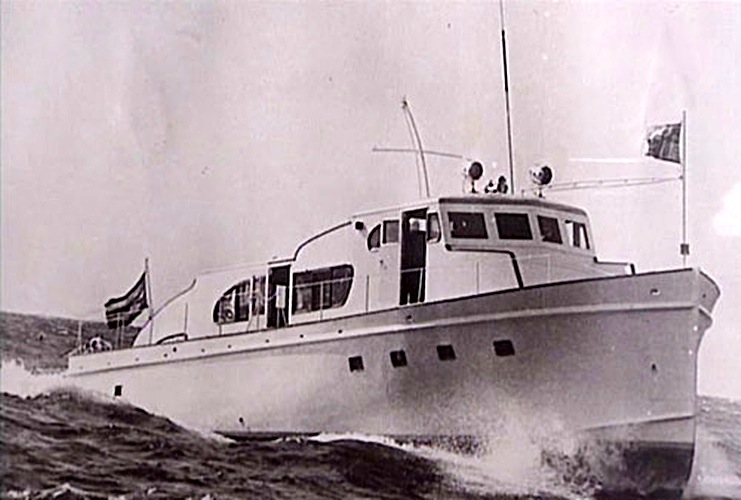 The Granma probably didn't cruise as fast as this when laden with 82 men, arms, ammunition, supplies, food, water, and spare fuel. (click to enlarge) Fidel purchased the boat with $15,000 US provided by Cuban-Americans living in Florida. Fund raising was coordinated by Carlo Prío Socarrás, a former Cuban president living in exile. The Granma was interesting to research. It's length was reported variously between sixty and eighty feet. The confusion may result from the fact that vessels may be measured along the keel or the deck or even the waterline. All three would be different for the same boat. Was it diesel powered or driven by gasoline engines? I found claims for both. However, all sources seem to agree that the Granma's engines were tired from years of use and that the vessel was seriously overburdened on the voyage to Cuba. Inasmuch as I have the advantage of some experience as a sailor, I was able to calculate just how severely the Granma was tested. Approximately 82 men voyaged on the Granma from the Tuxpam River on the East Coast of Mexico to the eastern end of the island of Cuba. (I say approximately because reports vary.) That's about 70 more than I would have attempted to carry on that trip. Allowing 250 pounds for each man and the weapon, ammunition, and supplies he carried, I calculated that the Granma sailed with its normal load line (waterline) submerged by at least six inches. That may not seem alarming to you. The vessel would still have plenty of reserve buoyancy to remain afloat in a mill pond. Unfortunately, they weren't crossing a mill pond. Even more problematic, that load would have greatly raised the boat's center of gravity, making it extremely unstable. Granma's buoyancy and stability were both put to the test as soon as it crossed the bar from the Tuxpam River into the Gulf of Mexico. Records show that the Fidelistas departed at approximately 1:00 am on November 25, 1956, to sneak past Mexican authorities in the dark. There was no guarantee that the Mexicans would permit their voyage to begin from their shores. A waning quarter moon would have provided the helmsman with just enough light to steer the channel, and not enough light to illuminate the yacht for sentries on shore. 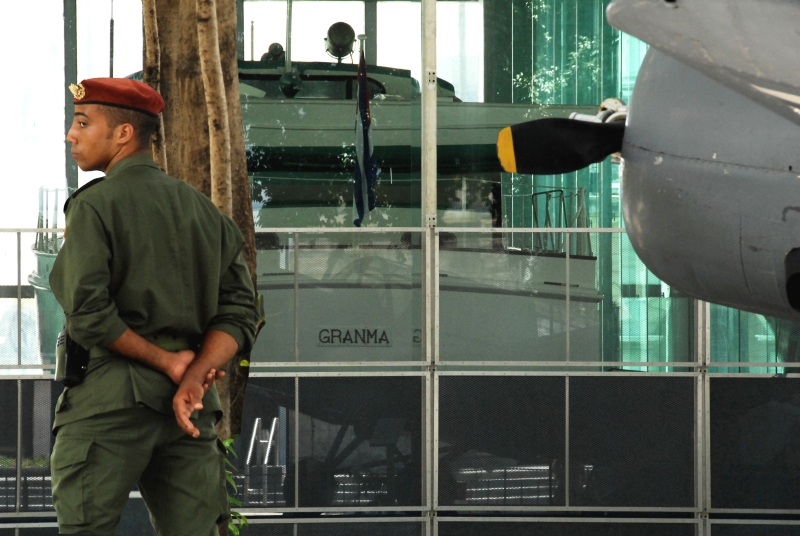 Granma on display behind glass in a museum (click to enlarge) Records show that a storm was sitting just off shore that night, and it must have been driving waves into the river entrance as the Granma exited. I can only imagine the pilot, Norberto Collado Abreu, a World War II veteran of the Cuban Navy, moving his cargo of men and equipment to make the bow more buoyant so that it could rise with the waves.
In my novel, Rebels on the Mountain, I populated the Fidelistas with a young engineering student from Havana University, to provide readers with a character to interpret the scenario. I imagined that such a man, with his engineering knowledge, would have appreciated the dangers they were facing. I attempted to illustrate this fact for readers by showing his reluctance to board the yacht when he saw how heavily it was laden. I then demonstrated his commitment to the revolution by having him step aboard at the last second as they departed the wharf. CubaWITH CASTRO IN PRISON and most of his rebel band dead, Batista was confident of his position. In 1954 he granted an interview with American correspondents. He proclaimed that Cuba had finally achieved political stability and was becoming more economically diversified. For proof of his claims, Batista released his political prisoners including Castro and the few survivors of his attack on the Moncada army barracks near Santiago de Cuba. 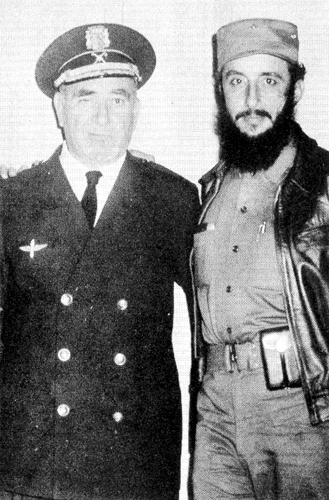 Alberto Bayo, with a Fidelista, was elevated by Castro to the rank of general in the Cuban army after Batista was deposed. (Click to enlarge) Batista obviously underestimated Castro. Had he been paying attention, Batista would have been alerted by Castro's continued political agitation, even while behind bars. Fidel renamed his organization the “26th de Julio Movement” (MR-26-7) commemorating the date of his attack on Moncada. Even so, Batista freed Castro under a program of general amnesty.
Castro was received by his followers with great fanfare and celebration. They carried him through the streets on their shoulders. Fidel immediately set about writing and appearing in radio interviews. Fidel and his brother, Raul, fled to Mexico which had a long tradition of sheltering exiled insurgents. They were followed by a few of the Moncada raiders and other dissidents. There they began planning an invasion of Cuba. Fidel enlisted Colonel Alberto Bayo, a fellow Cuban who had participated in the Spanish Civil War as well as the Cuban Revolution. Colonel Bayo distinguished himself for his courage and tactical acumen, but his side, the Loyalists lost and he took refuge in Mexico as an instructor at the Military Academy of Guadalajara until he joined the Fidelistas. It seems that Castro had little time for military training. Fortunately for Fidel, Batista's army was well trained but poorly led, and Castro's failings as a battlefield commander went unnoticed. While his rebels trained in Mexico, Castro was kept busy traveling the United States, soliciting funds for his invasion of Cuba. He found contributors within the Cuban-American community but most withheld any significant funding because Fidel refused to offer them high office in his new government. Castro resented the fact that so many were willing to sit back and let him risk his life to depose Batista, and then turn over the reins of government to someone else. Thus, much of Castro's backing came from Americans who were inspired by his impassioned pleas for Cuban liberty. Fidel wanted an airplane to insert his rebel band onto Cuban shores, but never garnered sufficient funds. He settled for an aging cabin cruiser, the Granma. 1/2/2013 12 Comments Will history absolve Castro or will he forever languish in the company of dictators?CubaFIDEL CASTRO'S RISE from revolutionary leader to dictator shouldn't have surprised anyone who has followed the history of Cuba. He began as his predecessors began, championing Cuba for Cubans, collaborated with foreign imperialists to create the illusion of economic stability, and then elevated himself to dictator when the people failed to grasp the reins of their own destiny. 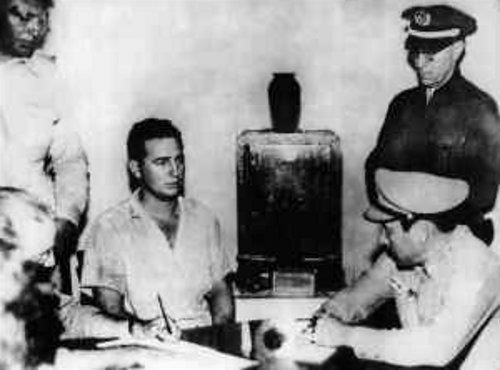 Fidel Castro under arrest after his attack on the Moncada army barracks (click to enlarge) Castro's career from the 1948 student riots in Bogotá, Columbia, to his exile from Cuba in 1953, was punctuated by his famous “History Will Absolve Me” speech. The illegitimate son of a wealthy island landowner, Castro discovered his voice and his ability to lead men during his student days at Havana University where he studied law. Many people look back at this period, especially his participation in the student riots, as proof of his communist leanings. However, I can't find any proof of this.
Castro's early writings and speeches seemed more consistent with the anarcho-syndicalist movement that originated in Eastern Europe during the late 19th Century and found great acceptance in Latin America during the early 20th Century. Although the Socialists and the Anarcho-Syndicalists both rejected capitalism, they were not allies. Karl Marx feared that the Anarcho-Syndicalists would dilute his movement and repudiated them. It is also significant that, shortly after driving Batista from the island, Castro made his first overtures for an alliance with the Americans. He only turned to the Soviets for economic help after the Eisenhower Administration openly rebuffed him and publicly insulted him. Kennedy exacerbated the rift by then mounting a series of attempts to either overthrow or assassinate Castro. Unfortunately, the Americans underestimated the man. It was obvious from the beginning that Castro was a firebrand. While still a student in Havana, Castro led an abortive raid against the Dominican Republic in a desperate bid to overthrown that island's iron-fisted dictator, Rafael Trujillo. When he graduated in 1950, Castro found little opportunity professionally in a society that boasted too many lawyers. He took a few pro bono cases, but spent most of his time working for the Orthodox Party that opposed Batista, fashioning itself as the true inheritor of the revolution. Castro was a candidate for the Cuban legislature in 1952 when Batista seized control of the government and suspended the constitution. Championing the restoration of constitutional government on the island, he then led his abortive attack on army barracks at Moncada near Santiago de Cuba. His band of rebels had intended to seize weapons and ammunition there to arm their rebel band. Unfortunately, Castro was never an adept military commander and the mission failed through poor command and coordination. Most of his band was killed and the rest scattered. Castro was captured and would have been executed on the spot except for the intervention of his archbishop. Fidel's early education had been at the feet of the Jesuits and he was a pious man until he declared himself a communist. During his trial, Castro made a four-hour speech in his own defense in which he condemned Batista and his government, and declared that history would absolve him. He was sentenced to serve fifteen years in prison of the Isle of Pines, but was later exiled to Mexico. |
|
Copyright © 2000, 2001, 2002, 2003, 2004, 2005, 2006, 2007, 2008, 2009, 2010, 2011, 2012, 2013, 2014, 2015, 2016, 2017, 2018, 2019, 2020, 2021, 2022 Jack Durish All rights reserved
|
Web Hosting by iPage
|