JACK'S BLOG
|
|
|
7/14/2011 0 Comments A Dupe AbroadCubaANTHONY BOURDAIN VISITED Cuba in the most recent episode of his Travel Channel Series No Reservations and was treated to a grand tour of Havana by the Seguridad de Estado (SDE) – Cuba's Secret Police. 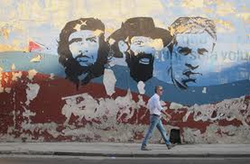 Inasmuch as Americans have little experience with secret police I will pause here to offer a brief explanation. Ordinary police forces serve and protect citizens by investigating crimes and apprehending criminals. Secret police serve and protect political regimes and states. Their name derives from the fact that they operate in secrecy so that they may observe otherwise law-abiding citizens who may threaten the extant political power in thought or in word without actually breaking any codified law. Thus, the main difference between them lies in the fact that ordinary policemen are reactive to crime, while secret policemen are proactive in apprehending before they can imperil the state.
So, how did Bourdain get involved with a secret police force? The answer to that question is wrapped up in the fact that eighty percent of the income derived from tourism in Cuba is used to finance the SDE, and the major purpose of Bourdain's show is to promote tourism. Unfortunately, prior to Castro's rise to power, most of the tourist industry in Cuba was owned and operated by mafioso. Since the SDE is the closest thing they have to a mafia, it was only logical that they should take over. Thus, the SDE was very interested in making sure that he met plenty of smiling Cuban faces to photograph, visited markets brimming with fresh produce, and ate at their best restaurants. Interestingly, the only quality restaurant that he visited featured a Basque chef from Spain serving non-Cuban cuisine. Almost every episode of No Reservations depends on local contacts to steer the production team to places that typify the local cuisine. Most often these guides are chefs themselves or food critics or restaurant owners. However, in this episode, there was no attempt to pass off the Cuban guides as anyone connected to food. The hungry look in their eyes was more wolfish than epicurean. Bourdain's SDE handlers led him to a marketplace where he praised the people for the quantity and quality of locally grown produce. We could see for ourselves the source of this bounty as Bourdain strolled through city parks amid rows of corn growing in place of lawns. He never mentioned that Castro had personally banned all such urban gardens until he realized that a starving populace might nurture an anti-revolutionary movement. Much of Bourdain's non-food related travelogue related to Havana. He lauded Castro for not defiling the timeless beauty of the city by erecting the same kind of glass and steel monoliths that characterize so many other cities that previously fell under the Soviet sphere of influence. This observation would be laugh-out-loud funny if it weren't so tragically misguided. Castro had no choice. He had no economy to support any sort of development or re-development. What little free capital he could scrape together was spent on military adventures in Africa and Latin America. And, yes, the timeless beauty of the city can be seen if you use a lot of imagination and ignore gaping holes, cracking streets and sidewalks, and peeling paint on every wall. Inasmuch as I was blessed with a remarkable ability to filter out political agendas like so much noisome static, I have been a fan of Bourdain's series for several seasons. I recognize that he is a undereducated though extremely literate chef. Thus, I accept his commentary on food while ignoring his political statements with ease in much the same manner that I can still watch Jane Fonda wiggle and writhe her obvious assets in Barbarella. I'm not fantasizing doing anything with her brain. Oh, and I'm not fantasizing doing anything with Anthony. Be sure to read Jack's novel, Rebels on the Mountain, available at all major eBook retailers. Click here for more information
0 Comments
7/9/2011 1 Comment Light My FireOpinionARE YOU OUTRAGED about something? Are you tired of waiting for someone else to do something about it? Are you prepared to fail? Most likely, you will fail to get your revolution off the ground and, even if you do, it will likely fail to achieve the results you want. Does this mean you shouldn't try? Quixotic struggles are among the most legendary, if not satisfying.  Every revolution has one major hurdle to overcome: to build a cadre of revolutionaries. You don't need everyone in a segment of society to rebel; hell, you don't even need a majority. But, you need a significant number to overcome the inertia of the status quo. The remaining population, probably one-third to one-half of your fellow citizens will choose to sit on the fence and complain regardless of the result. Thus, your first task is to find others who share your outrage. It is far, far easier to join with others who are ready to revolt than it is to ignite the spirit of revolution. Fortunately, the cybersphere makes this task far easier than it once was. Once upon a time you had to leave the comfort of your home and wander the streets looking for a mob carrying pitchforks and torches, check to make sure they were on the same side of the same issue that drove you into the streets, and then add your voice to their chorus. Historical examples include the Boston Massacre and the Storming of the Bastille. (Oh, did I mention that there was some risk involved in revolutions?) Modern mobs are able to form much more quickly and efficiently, and even organize themselves before they hit the bricks. The Tea Party in America and the phenomenon in the Middle East referred to as the Arab Spring are excellent examples. The Tea Party is like a Flash Mob in that it came into existence almost without warning and its members participate without pay for the simple joy of contributing to something greater than its individual members could affect. A leader of the cyber-revolution, Matthew Reinbold, made a short presentation at the Salt Lake Ignite Conference wherein he advocates using the communication and coordination potential of the cybersphere to create what I would term mini-revolutions, employing tribes of people who share a specific outrage or vision to solve society's problems. I came across a link to this presentation in the Kings of War blog, a group that shares my interest in revolutions, insurgencies, and insurrections. David Betz, the author of the posting there came away from Reinbold's presentation with concerns. Among them:
“... what is unclear is the ideology, the set of beliefs in the population about changing some elements of the structure and/or reward distribution of a society, which might serve to focus the abundant dissatisfaction with the status quo to which Reinbold is reacting. What are the ‘sunlit uplands’ towards which he imagines people striving? If you could identify it would you fight it or join it? I think the reason that ‘revolution’ seems in the air is that even a middle-aged, middle-class, mortgage-owning, ‘establishment’ figure like me needs to pause to ponder the answer to that.” I believe that the Tea Party provides ample evidence that even “middle-aged, middle-class, mortgage-owning, establishment figures” like Dr. Betz can be motivated to leave the comfort of their couches and rally for a worthy cause. One of Dr. Betz's other concerns was the Janusian quality of this environment; that it could have a subversive side. Interestingly, almost every person who rebels will be mirrored by one who will join a counter-revolution. (See With Little Less Than Savage Fury, published in American Heritage Magazine.) Keep in mind that modern counter-revolutionaries share the same advantages in coordination and communication as those they oppose. For example, George Soros and others have dedicated vast portions of their personal wealth to maintaining the status quo in American politics that the Tea Party is struggling to overthrow with unfunded citizen action groups. Unfortunately for Mr. Soros and his friends, history tends to fall on the side of the popular revolt versus wealth. 7/7/2011 1 Comment You da bomb!OpinionHOW CAN TERRORISTS bring down the United States? Just keep up the chatter about fanciful bomb schemes so that we will chase our tails and spend ourselves into oblivion. What's next? Laser beams shooting from the eyeballs? Switchblade fingernails?  The government has warned airlines that terrorists are considering surgically implanting explosives into people in an attempt to circumvent screening procedures, according to U.S. officials. – LA Times, 7/6/11
I guess I'll have to be patient and wait for the medical professionals to weigh in. Is there really a body cavity that can be used to convey a significant amount of explosive as well as a detonator? Where will the detonator control be placed? Will the belly button become the “Fire” button? If there is such a cavity, could I use it to carry a very personal computer? I have a better question: Why not stop the scare tactics and restore Civil Defense. Ever since 9/11, the politicians have used the terrorist threat to create new federal bureaucracies, increase defense spending, and infringe on personal liberty. We have been told to sit by and let the experts defend us from the creepy terrorists. (Call them creepy or anything you like except Islamic.) Remember the platitude: When seconds count, the police are only minutes away. We can update that now with a new version; When terrorists count down, Homeland Security is only thirty thousand feet below. It's my guess that the next attack won't come when or where we're expecting it. I also doubt if the cavalry will be within striking range when it occurs. Thus, it will be up to the people there to detect the threat, call for help, and delay the perpetrators. Has anyone prepared you for that? I know they haven't done anything for me or anyone I know. What is going to happen following an attack? Don't worry, the government will come to the rescue, sooner or later. Remember New Orleans and Hurricane Katrina? Do you have an axe in the attic so you can cut a hole in the roof and sit up there waiting for help? Has anyone prepared you to cope with a disaster? Again, no one has done anything for me or anyone I know. The truth is that if you mistakenly report suspicious activity you may be liable for defamation. If injure someone while detaining or restraining a terrorist, you may be guilty of assault and battery. If you attempt to help victims and harm them, you may be liable for their injuries. In all probability, adequate training and preparation of a Civil Defense organization would be far less expensive than attempting to counter every threat, real and imagined, and would be far less intrusive into our lives and liberty. Furthermore, it would probably be far more effective than anything the government is doing today. What do you think? |
|
Copyright © 2000, 2001, 2002, 2003, 2004, 2005, 2006, 2007, 2008, 2009, 2010, 2011, 2012, 2013, 2014, 2015, 2016, 2017, 2018, 2019, 2020, 2021, 2022 Jack Durish All rights reserved
|
Web Hosting by iPage
|